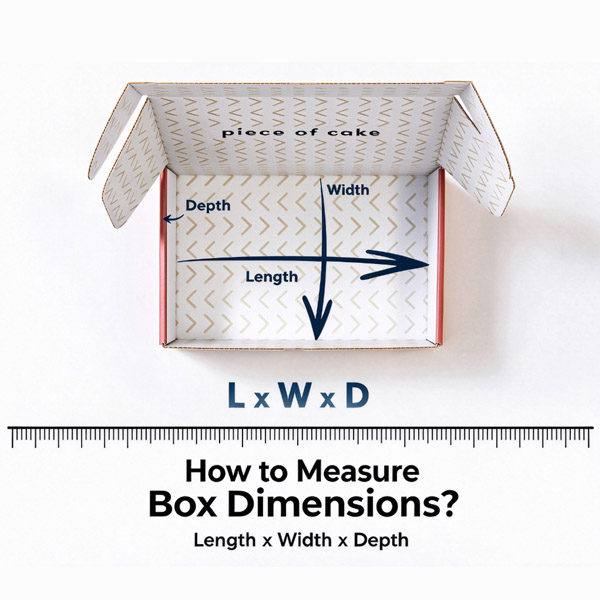
When shipping and storing products, properly sized packaging is critical. A perfectly fitted box keeps goods safe during transit or shelf storage while boosting perceived product value. Whether you run a brick-and-mortar retail shop or an e-commerce store, understanding accurate box dimensions helps you design high-impact packaging. Are you new to packaging sizing and eager to learn? This comprehensive guide walks you through practical tips and tools to take precise measurements and build boxes that fit your products perfectly.
What are Standard Box Dimensions?
First, let’s break down the three core measurements of a box. Note that many packaging professionals use depth and height interchangeably. The three dimensions are defined below:
- Length: The longest side of the box, measured horizontally from left edge to right edge of your product.
- Width: The shorter side of the box, measured from front to back.
- Height: Also referred to as Depth. This measurement runs vertically from the bottom edge to the top edge of the box.
This simple measurement method works for mailer boxes, rectangular cartons and nearly all common packaging styles.
How Do I Read the Dimensions?
Reading and writing box measurements follows a fixed format: Length x Width x Height For example, 15″ x 12″ x 3″ means the box is 15 inches in length, 12 inches in width and 3 inches in height.
Step-By-step Guide to Accurately Measure Box Dimensions
Want to master product and box measurement? Follow this simple workflow for precise results.
Gather Essential Measuring Tools
Start by preparing your supplies:
- Ruler
- Measuring tape
- Yardstick
- Straight edge
Step 1: Measure the Length Begin with the longest side of the box. Lay your measuring tool from the far-left edge to the far-right edge. Keep your tool straight to prevent reading errors.
Step 2: Measure the Width Next, measure the shorter side of the box. Again, keep the measuring tool level and straight across the two edges.
Step 3: Measure the Height Height is measured from top to base. For closed boxes, take measurements on the exterior. For open boxes, you can measure the interior. Hold your measuring tool perpendicular to the base to avoid inaccurate readings.
Volume Calculation of a Box
Once you have length, width and height, calculate the box volume. Volume calculation is a key step for material selection, cost planning and box structural design.
Formula: Length x Width x Depth = Volume
Multiply the three dimension values to get the total volume in cubic inches.
Interior vs Exterior Box Dimensions
Interior and exterior box dimensions are often different. Knowing both values lets you calculate true usable box volume.
- Correct internal dimensions ensure your product fits neatly inside, eliminating excess empty space that allows items to shift.
- Accurate external dimensions are essential for shipping, warehousing and efficient product storage.
How to Measure Boxes for Inserts and Dividers
Precise sizing for inserts and dividers adds extra protection for products while in transit.
Measuring for Inserts
- Take all three internal measurements of your box
- Add a small tolerance gap; ⅛ inch or 1/16 inch works best. This gap creates a snug fit.
- Double-check the inside measurements of your packaging
- Fit the inserts inside the box to verify the sizing
Measuring for Dividers
- Measure the internal width of your packaging
- Account for the thickness of each divider panel
- Leave a minimum of one inch gap between dividers to safely arrange your products
Common Mistakes to Avoid While Taking Box Dimensions
Keep these pitfalls in mind when measuring for custom boxes:
- Always prioritize internal dimensions for box design. Many buyers mistakenly use outer measurements to create custom packaging.
- Never guess product sizes. Use a measuring tape, ruler or vernier caliper to capture real measurements.
- Follow the standard order: Length → Width → Height.
- If your product uses wrapping paper, bubble wrap or protective sheets, include the thickness of these materials and add enough clearance space.
- Avoid packaging that is overly tight or excessively loose for your items.
Ready to Create Packaging with Size Accuracy!
Using accurate custom box dimensions helps build a professional brand image and makes your product look polished on retail shelves. The team at A BOX STORE can assist you to select the ideal box size for a snug product fit.
FAQs
Q: What tools are best for measuring box dimensions accurately? A measuring tape and ruler are the primary tools. You will also need pen and paper to record your measurements.
Q: What’s the difference between interior and exterior box dimensions? Interior dimensions describe the usable space inside the package. Exterior dimensions refer to the full outer size of the finished box.
Q: How do box dimensions affect product protection during shipping? Selecting the correct box size is vital to keep products safe in transit and on display. Properly sized boxes hold items securely and reduce damage risk caused by shifting and impact.
Q: How do you measure irregularly shaped packages? For irregular items, measure the maximum length, width and depth. You can then calculate the required box volume and inner dimensions for your custom carton.